
Authors: Kaylin McNulty, Ruth Y. Ewing, Beth Peterman, Jill B. Hudnall, Robert W. Wills, William I. Jumper, Debra Moore, Stephen R. Reichley, and Mark L. Lawrence
Abstract
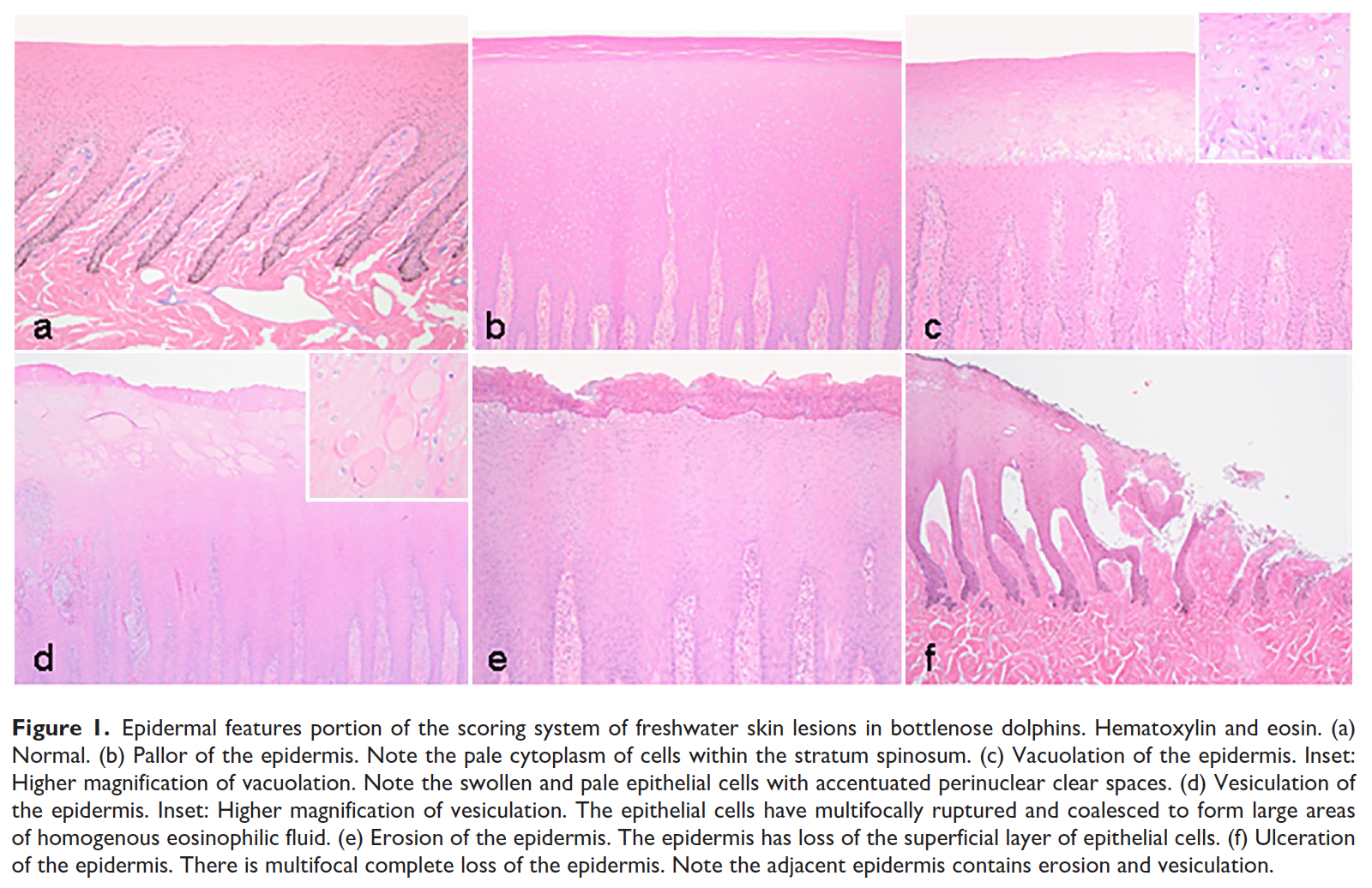
Low-salinity water exposure (freshwater exposure) is an emerging disease of cetaceans worldwide. The disease, termed “freshwater skin disease,” causes gross skin lesions that appear as multifocal to coalescing, irregularly marginated targetoid patches that vary in color from pale gray to yellow to orange to green depending on the involvement of secondary bacterial and/or fungal/algal overgrowth. Histologically, these skin lesions range in severity from hydropic degeneration to widespread necrosis with associated bacterial and/or fungal/algal overgrowth. Currently, there is no histopathologic scoring system for freshwater skin disease lesions in any species. In this study, we created and validated a histopathologic scoring system for freshwater skin disease lesions in common bottlenose dolphins (Tursiops truncatus) compared with control bottlenose dolphins based on epidermal features, the presence/absence and location of suppurative inflammation, and the presence/absence of organisms. We also identified common histologic artifacts, such as postmortem epidermal changes, saprophytic bacterial overgrowth, vesiculation mimicking fungal organisms, and freshwater disease-associated eosinophilic inclusion-like bodies mimicking poxviral inclusions. In addition, salinity measurements taken from the stranding site were found to correlate with a diagnosis of freshwater skin disease in dolphins.
Read the full publication at https://doi.org/10.1177/03009858261416940.