
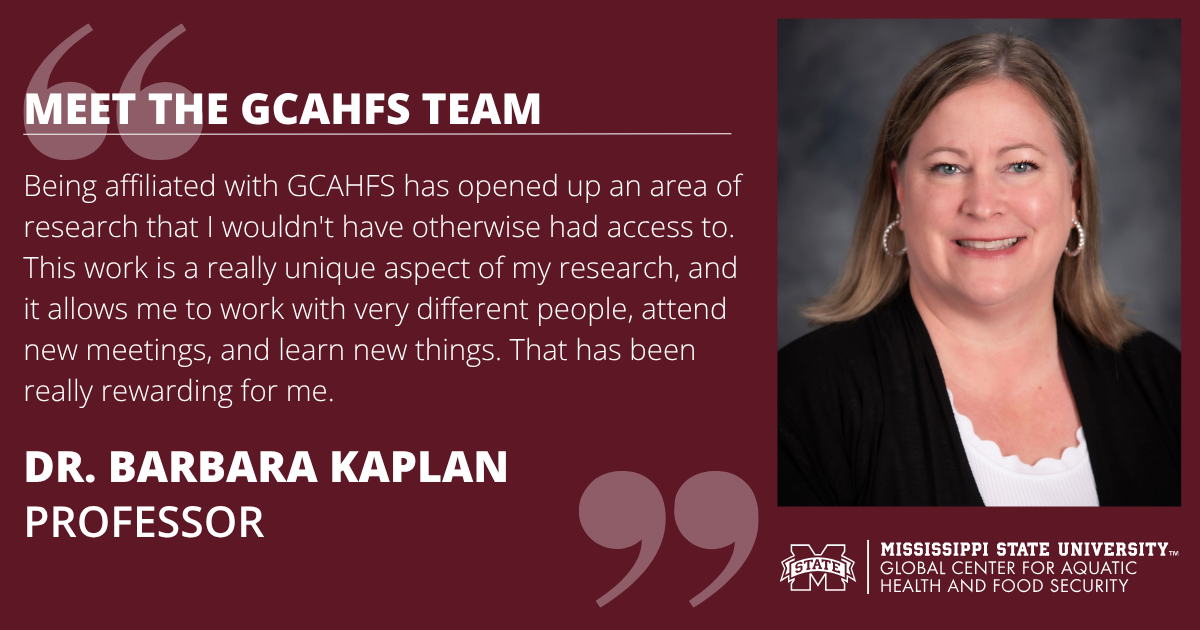
What is your role at Mississippi State University and how are you affiliated with GCAHFS?
I am a professor of immunotoxicology at Mississippi State University's College of Veterinary Medicine, which means I study the effects of drugs and chemicals in the immune system. My affiliation with the Global Center for Aquatic Health and Food Security started in 2022, when I was asked to help out with some quantification of environmental chemicals that can be found in the tissues of dolphins that stranded from the Mississippi Sound. This work is important because dolphins can serve as what we call "sentinel species," which means that if we understand what's happening with dolphins, that helps us understand what might be happening not only to people but the marine environment as well.
What is the most rewarding part of being affiliated with GCAHFS?
Being affiliated with GCAHFS has opened up an area of research that I wouldn't have otherwise had access to. I certainly don't know a lot about dolphins, but I know more now than I did a couple of years ago. This is a really unique aspect of my research, and it allows me to work with very different people, attend new meetings, and learn new things. That has been really rewarding for me.
How has GCAHFS advanced your career or schooling?
We have been lucky enough to get two peer-reviewed publications from our work so far. We are looking at environmental chemicals in the tissues of dolphins that strand from the Sound so we can get an idea of what's happening with the dolphins, to what they might be exposed, and also quantify some of the changes that might be happening in the Sound itself—and how that could reflect on dolphin health. The other really rewarding thing that has happened for me is that I was able to train and mentor a graduate student. That student is following up on some of our observations and trying to understand how the dolphins get exposed to these chemicals and quantify that information for us.
What is a fun fact about you?
I'm originally from Michigan, and my previous job before I came to Mississippi State University was at Michigan State University, so I was easily able to transfer from MSU to MSU. Now I've embraced Maroon Fridays!
Published April 2, 2026