
What is your role at Mississippi State University and how are you affiliated with GCAHFS?
I am an Assistant Research Professor at Mississippi State University, based at the Delta Research and Extension Center. I lead the Catfish Nutrition Laboratory at the Thad Cochran National Warmwater Aquaculture Center, where my research focuses on applied fish nutrition and health, and the development of sustainable feed ingredients.
I am affiliated with the Global Center for Aquatic Health and Food Security as a member of the Technical Working Group of the FAO Reference Center on Antimicrobial Resistance and Aquaculture Biosecurity. In this capacity, I contribute to interdisciplinary efforts to address antimicrobial resistance in aquaculture by developing nutritional strategies and feeding management to enhance fish health and reduce reliance on antibiotics. My work integrates fish nutrition and health to support aquaculture systems, aligning closely with GCAHFS’s mission to improve aquatic animal health and food security worldwide.
What is the most rewarding part of being affiliated with GCAHFS?
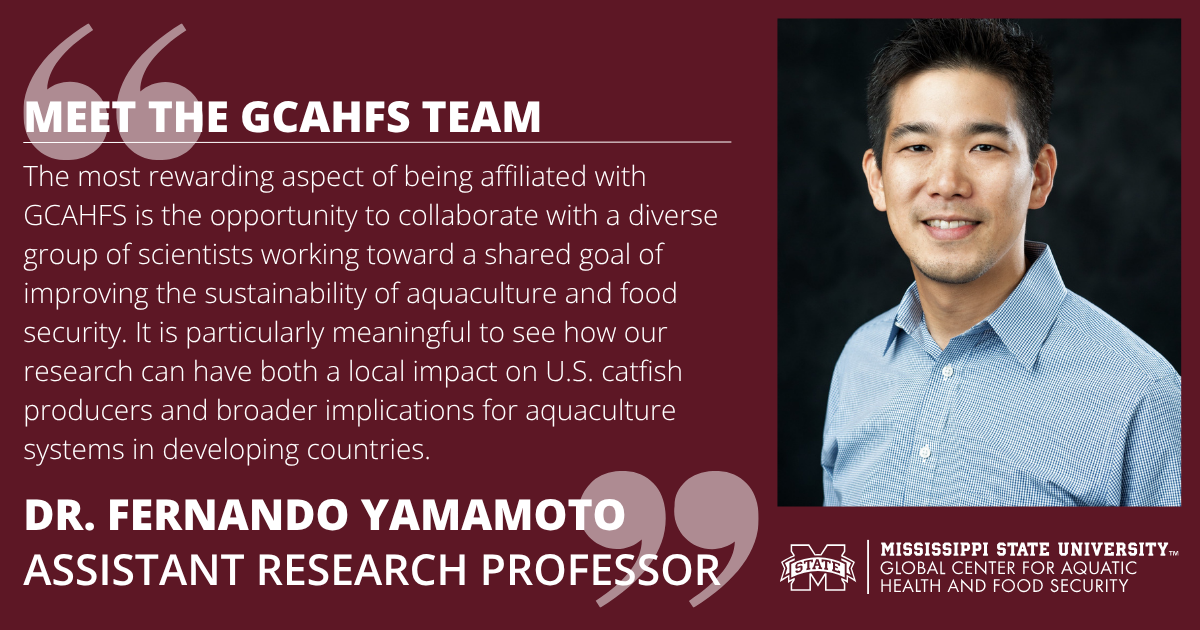
The most rewarding aspect of being affiliated with GCAHFS is the opportunity to collaborate with a diverse group of scientists working toward a shared goal of improving the sustainability of aquaculture and food security. The interdisciplinary nature of the center allows us to tackle complex challenges, such as antimicrobial resistance, from multiple angles, integrating nutrition, disease management, and biosecurity. It is particularly meaningful to see how our research can have both a local impact on U.S. catfish producers and broader implications for aquaculture systems in developing countries.
How has GCAHFS advanced your career or schooling?
GCAHFS has significantly enhanced my career by expanding my research network and providing opportunities for international collaboration. Through the center, I have been able to meet and collaborate with experts across disciplines, contribute to global discussions on antimicrobial resistance, and participate in workshops and outreach initiatives. These experiences have strengthened both the scope and impact of my research program, positioning it within a global context while maintaining strong ties to industry needs. Additionally, involvement with GCAHFS has supported the training and development of my graduate students by exposing them to multidisciplinary and global perspectives in aquaculture research.
What are some fun facts about you?
- I was born and raised in Brazil, but both sides of my family have Japanese roots—my grandparents immigrated from Japan as children.
- As a kid, I learned how to fish from my father and grandfather, which sparked my interest in fisheries. We also always had fish tanks at home, and that early exposure to water quality and to the dynamics and roles of each living organism in maintaining a healthy aquatic environment ultimately led me to pursue aquaculture as a career.
- Outside of work, I enjoy spending time with my wife and our two dogs. We like to stay active during our time off by hiking, kayaking, and exploring nature whenever we can.
Published May 28, 2026