
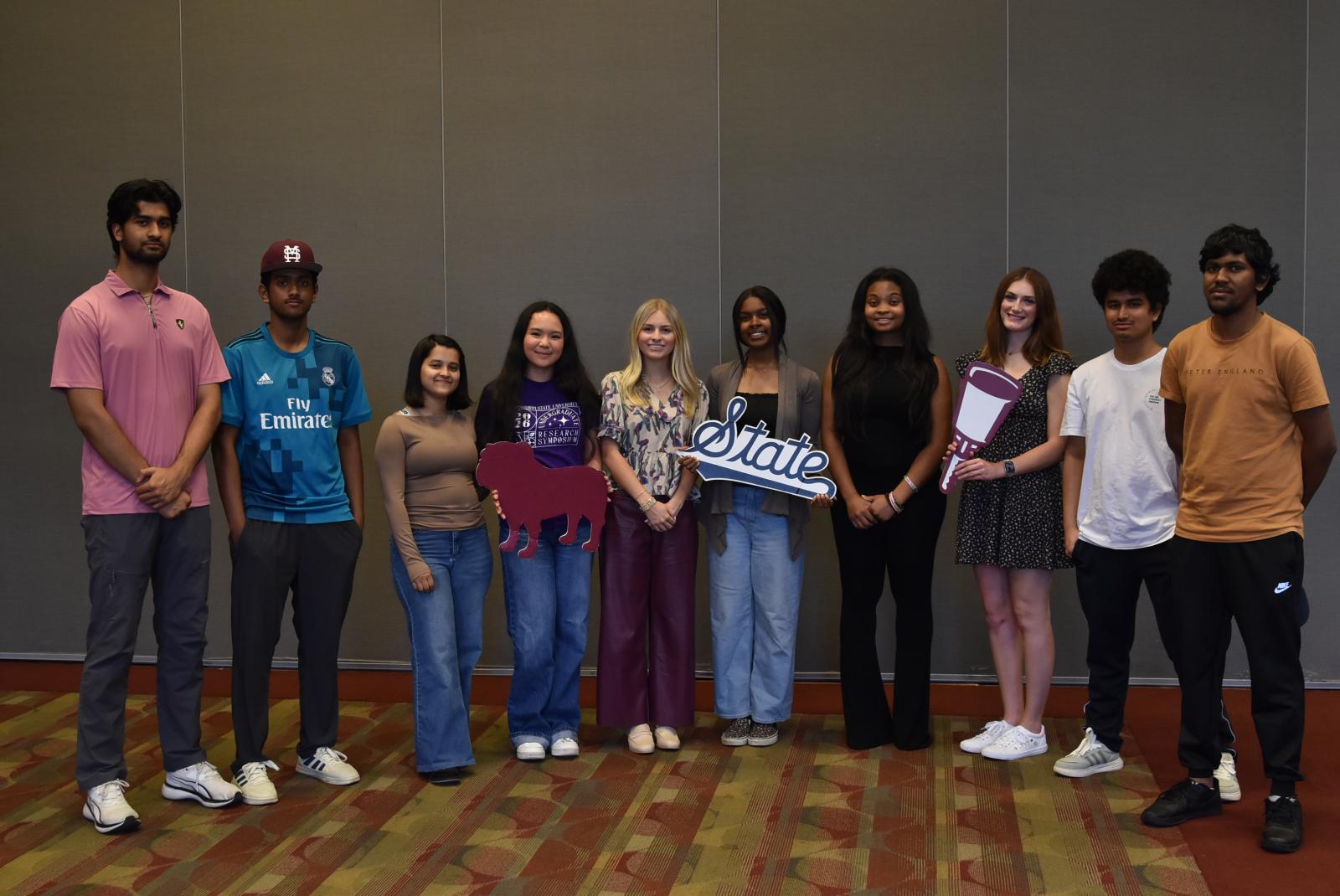
Isabella Garrard (fourth from left) and Riley Laird (third from right) pose with a group of BRIDGES undergraduate scholars. Garrard and Laird supported research and communications work with the Global Center for Aquatic Health and Food Security during the Spring 2026 semester.
By Laura Zseleczky
Two Mississippi State University students spent the Spring 2026 semester gaining hands-on experience at the Global Center for Aquatic Health and Food Security (GCAHFS) through the BRIDGES Undergraduate Research Program, an initiative designed to connect undergraduate students with meaningful research opportunities and professional mentorship. The program helps students deepen their understanding of research while exploring future academic and career pathways.
Riley Laird, a junior double-majoring in microbiology and Spanish, worked with the center’s Gulf Coast Aquatic Health Lab team to support marine mammal and sea turtle health projects. Throughout the semester, she assisted with archiving tissue samples and microscope slides, trimming tissues for histology, and observing diagnostic procedures, including a dolphin necropsy.
The experience allowed Laird to see firsthand how research and diagnostic work are conducted outside the classroom while exploring her longstanding interest in marine biology.
“Over the course of this program, I was able to learn about what research looks like outside of the classroom and explore my lifelong passion for marine biology,” Laird said. “I loved getting to participate in the dolphin necropsy, which was the highlight of this program for me.”
Laird credited her mentor and GCAHFS Research Associate Jill Hudnall for helping her develop a deeper understanding of research careers.
“Jill taught me how to complete all of the tasks as well as explained why we were doing them,” Laird said. “She was also willing to explain her career and research and give me guidance on pursuing that path.”
Meanwhile, Isabella Garrard, a freshman majoring in data science, worked with the GCAHFS Communications Manager to support the center’s outreach and engagement efforts. Her role combined science communication and data analytics, giving her the opportunity to help launch the center’s Instagram presence while developing tools to measure audience engagement.
Garrard developed and executed a social media launch strategy that helped grow the account to more than 50 followers and generated engagement across dozens of posts. She also began building a customized Power BI dashboard to organize and analyze social media performance metrics, providing the center with a more effective way to evaluate outreach efforts.
Through the experience, Garrard gained a broader perspective on the many roles that support scientific research.
“Through our discussions, I learned that research extends beyond conducting experiments or collecting data,” Garrard said. “Roles like science communication and outreach are equally important because they help support, strengthen and share the impact of research with broader audiences.”
Garrard said one of the most meaningful aspects of the semester was collaborating with staff across the center and feeling like a valued member of the team.
“Although I was an intern, I genuinely felt treated as a valued member of the team throughout the semester,” she said. “I believe science communication serves as an essential bridge between research and the broader public, helping make important work more accessible and impactful.”
As part of the BRIDGES program, both students also presented their work during Mississippi State's Undergraduate Research Symposium, where they shared their semester-long projects and experiences with faculty, staff and fellow students. The symposium provided an opportunity for Laird and Garrard to reflect on their work, communicate what they learned, and gain experience presenting their projects to a broader audience.
For both students, the semester offered more than technical skills and project experience. It provided a closer look at the many ways people contribute to scientific discovery and impact. Whether through hands-on laboratory work or strategic communications and outreach, the experience helped each student explore potential career paths while building connections with professionals working across the aquatic health field.
“Programs like BRIDGES provide students with opportunities to apply classroom knowledge in real-world settings while contributing to meaningful work. Riley and Isabella each brought unique skills and perspectives that strengthened our team and advanced our mission,” said GCAHFS Associate Director Dr. Stephen Reichley.
The Global Center for Aquatic Health and Food Security works to reduce world hunger and improve aquatic animal health. To learn more about GCAHFS and the Gulf Coast Aquatic Health Lab, visit www.gcahfs.msstate.edu.
Published June 24, 2026