
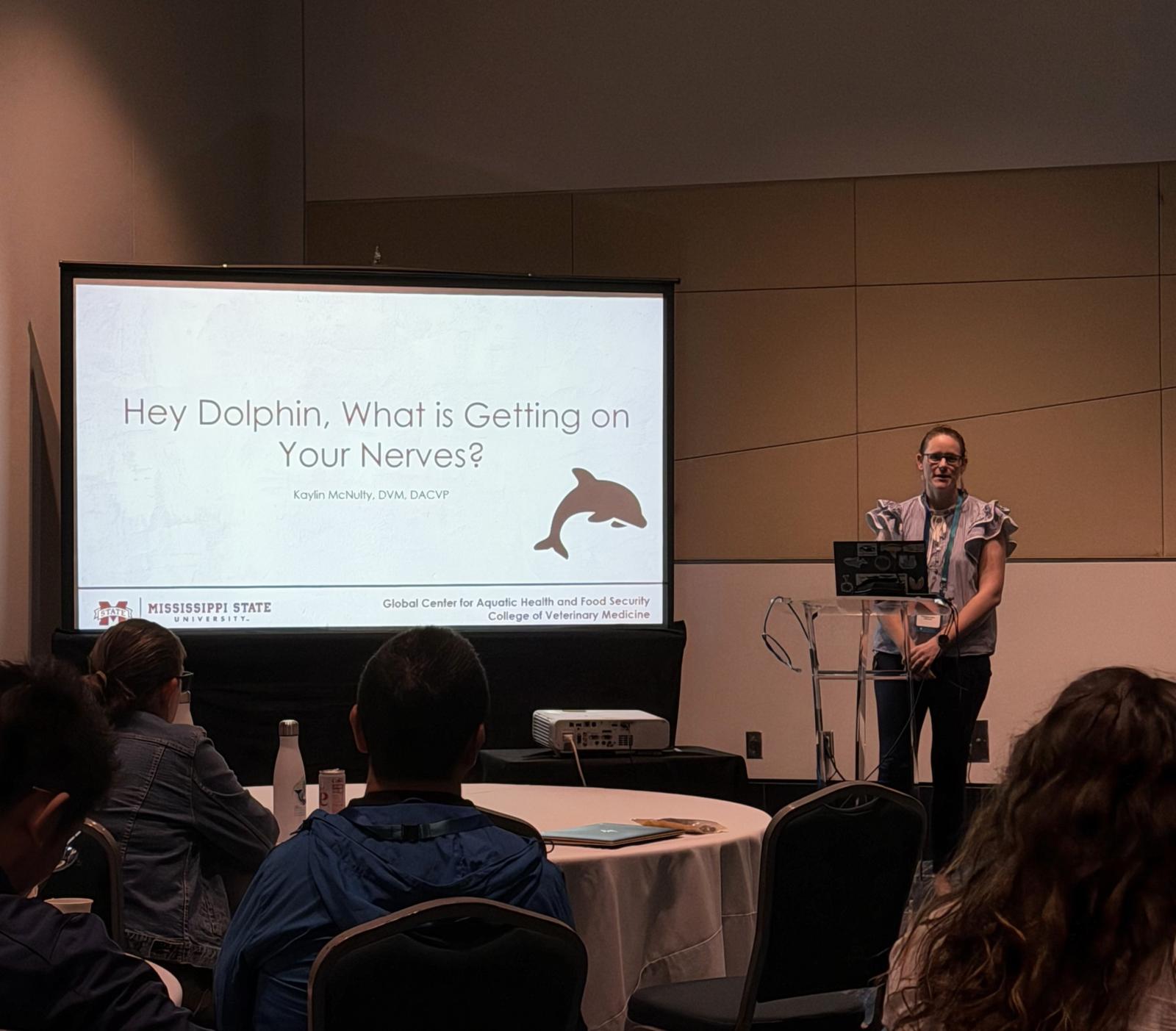
The Global Center for Aquatic Health and Food Security (GCAHFS) supported Dr. Kaylin McNulty’s participation in the 26th Biennial Conference on the Biology of Marine Mammals in San Juan, Puerto Rico, where she shared Mississippi State University expertise through workshop leadership, invited presentations and scientific service.
McNulty co-led a full-day marine mammal forensic investigation workshop with Megan Stolen. The workshop brought together professionals to share approaches for investigating marine mammal injuries and deaths, with sessions addressing forensic necropsy, large whale investigations, vessel strikes, firearms injuries and other evidence of human interactions.
McNulty delivered presentations on forensic necropsy and case studies and helped lead two hands-on portions of the workshop. Participants explored forensic tools and techniques, including the use of alternative light sources to examine evidence and microscopes to compare ivory with bone. Materials supplied by collaborating experts provided opportunities to examine fishing gear and other items relevant to investigations of human interactions with marine mammals.
The workshop reflected a collaborative effort among presenters and partners who contributed expertise, specimens, equipment and logistical support. These contributions connected classroom instruction with practical exercises relevant to marine mammal investigations.
The following day, McNulty delivered two invited presentations at the VIII Edition – What is New in Marine Mammal Pathology workshop. Her presentations, “Hey Dolphin, What Is Getting on Your Nerves?” and “Why Diamonds Are NOT a Dolphin’s Best Friend,” addressed dolphin cases involving brucellosis and Erysipelothrix rhusiopathiae infection, respectively. The cases contributed to a broader exchange on emerging infectious diseases, diagnostic approaches and challenges in marine mammal health.
Beyond her workshop contributions, McNulty volunteered as a judge for scientific presentations and posters, supporting the evaluation and recognition of research shared at the conference. She also participated as a member of a Society for Marine Mammalogy committee, seeing the results of collaborative work undertaken before the meeting.
The conference created opportunities to discuss potential diagnostic collaborations and training experiences with marine mammal health organizations. Conversations with colleagues in Puerto Rico and at The Marine Mammal Center explored possible histopathology support and future opportunities for pathology residents at Mississippi State University College of Veterinary Medicine to gain experience with marine mammal cases.
Through support for faculty participation in international scientific meetings, GCAHFS helps connect Mississippi State expertise with colleagues working to advance aquatic animal health around the world. McNulty’s contributions demonstrate how veterinary pathology, practical training and professional collaboration can support marine mammal health and conservation.
Dr. McNulty is a faculty member in the College of Veterinary Medicine, in the Division of Agriculture, Forestry and Veterinary Medicine at Mississippi State University.